- Published on
TEAS Solar Panel Passage: The White House, Three Presidents, and Why This Reading Section Trips Everyone Up
- Authors

- Name
- TheAbgNews Team
- @theabgnews
Why I Am Writing This
So you Googled "solar panel passage TEAS" and landed here. Good.
Most pages on this topic give you a list of bullet points and call it a guide. That is not what helped the nursing students I know pass this section. What helped them was actually understanding WHY each answer is correct. Not just knowing the answer. Knowing the reason behind it.
That is what this post does.
I went through every Quizlet flashcard set, every forum thread, every question students shared about this passage. I pulled out every question type, every trap answer, every pattern. And I am going to walk you through all of it in plain language.
If you are preparing for ATI TEAS 7 and the reading section is making you nervous, this is going to help.
What Is This Passage Even About
The solar panel passage TEAS is a reading comprehension passage in the ATI TEAS exam. It shows up in the Key Ideas and Details section of the reading portion.
Here is the thing. A lot of students panic when they see the words "solar panel" and think they need to know science. You do not. This passage is not testing your science knowledge. It is testing whether you can read carefully and think clearly.
The passage is around 300 to 400 words. It is a historical text about solar panels at the White House. Three presidents made decisions about those panels across a span of about 30 years. Your job is to read and answer questions based only on what the passage says.
That is it.
The Actual Story — Carter, Reagan, Obama
Let me give you the history so you walk into this passage knowing what you are reading.
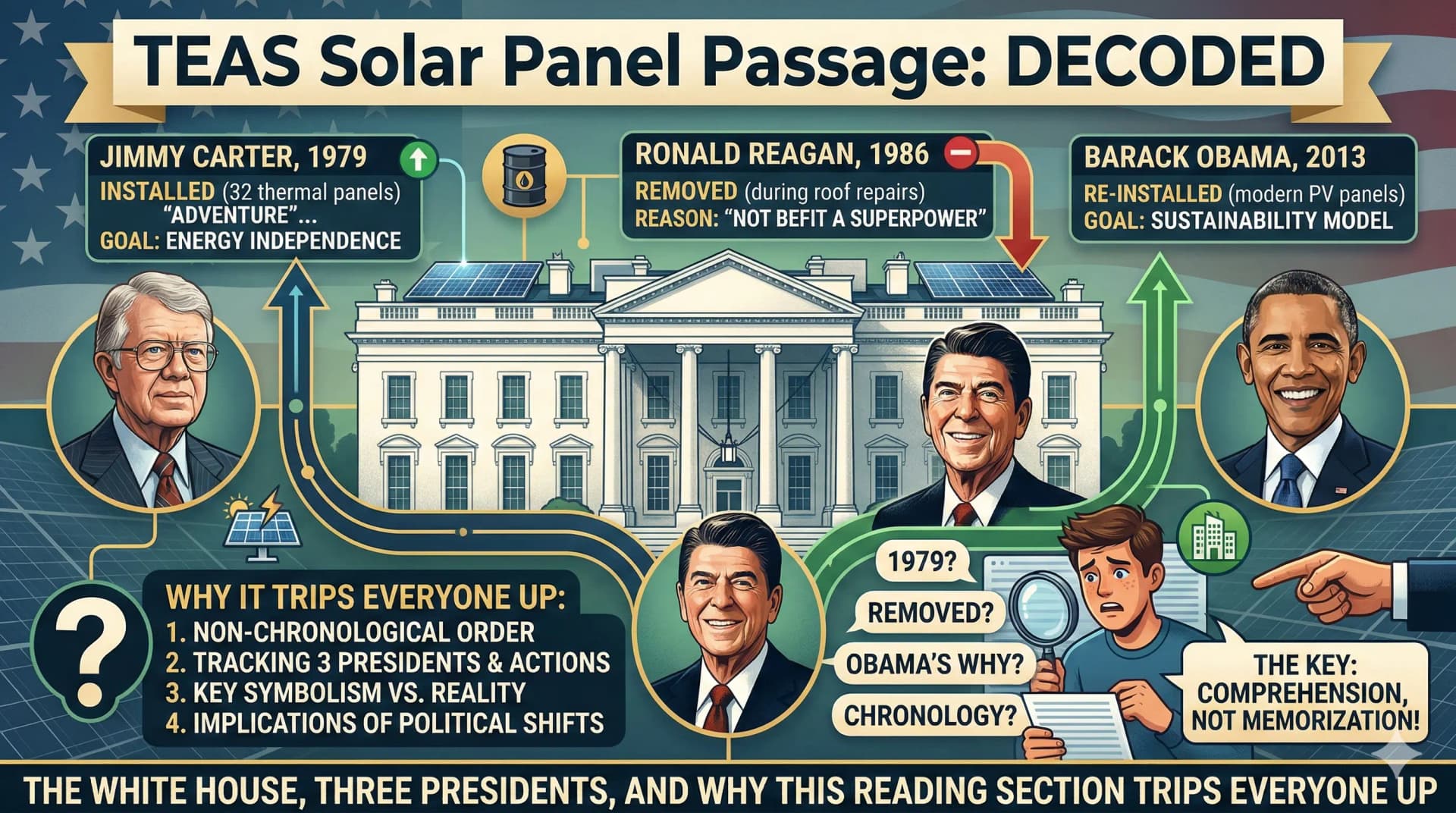
Jimmy Carter — 1979
President Carter installed 32 solar panels on the White House roof. This was during a period when the United States was going through an energy crisis. The Arab oil embargo had made fuel expensive and difficult to get. Carter wanted to show Americans that alternative energy was possible.
He said something very important in the passage. He called the solar panels "a small part of one of the greatest and most exciting adventures ever undertaken by the American People."
Write that quote down. You will see a question about it.
Ronald Reagan — 1981
Reagan became president in 1981. He had very different views on energy. He removed the solar panels from the White House roof. The passage says this happened during a roof repair or renovation.
Notice what the passage does NOT say. It does not say Reagan hated solar energy. It does not say he removed them out of spite. It just says they were removed and never put back during his time. This matters a lot for the inference questions.
Barack Obama — 2010
President Obama had solar panels installed again in 2010. The passage says this was "as part of his administration's focus on environmental issues."
Now here is something important. The passage starts with Obama. Not Carter. The author jumps back in time after the opening paragraph.
You will be asked why the author did that. We will cover that below.
The Real TEAS Questions With Answers and Explanations
These are the actual question types that appear on the solar panel passage TEAS. I am giving you the full explanation for each one, not just the answer letter.
Question 1 — Which of the following best summarizes the text?
Options usually look like this:
- A. Carter installed solar panels in 1979 to save energy.
- B. Diverse presidential philosophies have affected White House energy resource use.
- C. Obama and Carter both believed in protecting the environment.
- D. Reagan removed the solar panels during a roof renovation.
Answer: B
Here is why. A summary has to cover the whole passage. Options A and D are just single facts from single paragraphs. Option C is an opinion that the passage does not fully support. Option B covers the entire story. Three presidents. Three different beliefs. Three different decisions. That is the whole passage in one sentence.
When you see a "summarize the text" question, immediately cross out anything that sounds like just one paragraph's detail.
Question 2 — According to the passage, which event occurred second?
Options usually list events from different time periods, like:
- A. Carter installed solar panels on the White House in 1979.
- B. Reagan took office in 1981.
- C. Obama installed solar panels in 2010.
- D. A solar water heater was added in 2011.
Answer: B
Carter's installation happened in 1979. That is first. Reagan taking office in 1981 came second. Panels were removed after that. Obama's work was in 2010. Water heater in 2011.
The trick here is that the passage does NOT follow this order. Obama is mentioned first. So students mix up "what the passage talks about first" with "what happened first in time." These are two completely different things.
Always go by dates in the text, not by which paragraph comes first.
Question 3 — Which sentence from the passage includes biased language?
Options usually include:
- A. In 2010, President Obama decided to install solar panels on the White House.
- B. Carter said the panels were "a small part of one of the greatest and most exciting adventures ever undertaken by the American People."
- C. President Reagan took office in 1981.
- D. Solar panels were installed on the White House roof.
Answer: B
Biased language means opinion words. Words that show emotion or judgment. Carter called this adventure "the greatest" and "most exciting." Those are opinion words. They show enthusiasm and personal feeling.
Options A, C, and D are plain facts. No emotion. No judgment. Just information.
Any time you are asked about bias, look for words that describe something as good, bad, amazing, terrible, important, exciting. Those words signal opinion.
Question 4 — Why did the author discuss Obama's installation first, before Carter's?
Options usually include:
- A. To confuse the reader with a non-chronological order.
- B. To engage the reader with a current event.
- C. To show that Obama was more important than the other presidents.
- D. To make the passage shorter and easier to read.
Answer: B
Starting with something recent and relevant pulls readers in. Obama's installation was a current event at the time this passage was likely written. By opening with that, the author gives the reader a familiar starting point before going back in history.
Option A is wrong because confusing readers is never the point of good writing. Option C is wrong because the passage does not rank the presidents. Option D makes no sense.
Question 5 — Which inference can be made about President Carter?
Options usually include:
- A. Carter was not successful in his presidency.
- B. Carter did not understand energy policy.
- C. Carter was ahead of his time in thinking about energy conservation.
- D. Carter installed solar panels only because of political pressure.
Answer: C
The passage says Carter installed solar panels in 1979, during the energy crisis. His quote about the "greatest adventures" shows genuine belief in what he was doing. And the fact that his decision was reversed and then revisited 30 years later shows his thinking was ahead of its time.
Inference questions ask you to go one step beyond what the passage literally says. But you still have to stay close to the text. You cannot say he was a failure or that he was pressured. The passage does not say that.
Question 6 — Which conclusion can the reader draw from the passage?
Some versions of this question ask whether the White House was the first building in America to use solar panels. The passage does not say that. So you cannot conclude it.
This is a trap. Students assume the White House must have been first because it is so prominent. But the passage never says this. If the passage does not say it, you cannot choose it.
Always ask yourself: "Is this conclusion in the passage or am I adding my own knowledge?"
The One Thing Most Students Get Wrong
This is the part most blogs skip. And it is the most important thing I can tell you.
The TEAS reading section rewards staying inside the passage. Not outside it.
A lot of smart students fail questions because they bring in what they already know. They know Reagan was conservative. They know Obama was liberal. They know solar panels are good for the environment. So they pick answers that match their outside knowledge.
Wrong approach.
The passage is the universe. Everything you answer has to live inside that universe. If the passage does not say it, you do not know it for this exam.
This is especially true for inference questions. The inference has to be supported by something actually written. Not by what makes sense from your general knowledge.
How to Read Any TEAS Passage Faster
Here is a method that actually works. Not a theory. A real method.
Step one. Read the questions first. Before you touch the passage, read all the questions quickly. Just 30 seconds. This tells you what to look for. Now when you see Carter's quote, your brain already knows that is relevant to the bias question.
Step two. Mark dates and names on scratch paper. Write Carter = 1979. Reagan = 1981. Obama = 2010. Three lines. Done. This takes 20 seconds and saves you from re-reading the whole passage for sequence questions.
Step three. Circle opinion words while you read. Any word that sounds like a feeling or judgment, circle it. Greatest. Exciting. Symbolically. Focus on. These are your bias clues.
Step four. Use elimination on every question. Do not hunt for the right answer. Hunt for wrong answers. Cross out two obviously wrong options. Then pick between the remaining two. This reduces mistakes significantly.
Step five. Never leave a question blank. Even if you are not sure, make a choice. There is no penalty for guessing on the TEAS.
Common Mistakes That Cost Points
Picking the answer that "sounds important" instead of the one that covers the whole passage.
This happens on main idea questions. Carter's quote sounds impressive. Reagan's removal sounds dramatic. But neither one is the main idea. The main idea is the big theme: different presidents, different energy decisions.
Assuming "biased" means "negative."
Carter's quote is biased and it is positive. Bias is any language that shows opinion or emotion, good or bad. Students look for angry or critical words and miss the enthusiastic ones.
Confusing the order of the passage with the order of events.
Obama is mentioned first in the passage but he is not the first president to act. Always use dates, not paragraph order.
Reading too fast and not going back to check.
You have about 7 to 8 minutes for this passage and its questions. That is enough time if you use it well. Students who rush miss words like "not" or "only" in question stems and choose the opposite of the right answer.
Bringing in outside knowledge.
The White House is famous. You probably know things about these presidents. Forget all of that during the reading section. Read only what the passage gives you.
FAQ
Q: Will I definitely see the solar panel passage on my TEAS exam?
Not necessarily. ATI uses multiple passage sets. But this passage is widely reported and has appeared on many exams. More importantly, practicing with it builds the exact skills you need for whatever reading passage appears on your test — inference, bias detection, sequence, and main idea identification.
Q: How many questions come with this reading passage?
Usually 4 to 6 questions. They test a mix of skills: main idea, sequence of events, biased language, inference, author's purpose, and vocabulary in context.
Q: I keep second-guessing my answers on reading. What should I do?
First instincts are usually better than second guesses on reading comprehension, especially for inference questions. The reason people change correct answers is because they start thinking too hard and drift from the text. If you can point to a specific sentence or word in the passage that supports your answer, stick with it.
Q: Is the TEAS reading section hard?
It depends on your reading habits. If you read regularly, even news articles or nonfiction, the reading section feels manageable. If you have not done much close reading recently, it takes practice. The solar panel passage is actually one of the more straightforward ones because it has a clear structure and real dates to anchor your answers.
Final Thoughts
Look, the solar panel passage TEAS is not as scary as people make it out to be once you know the story it tells.
Three presidents. Three different calls on energy. Carter put them up in 1979. Reagan took them down in 1981. Obama put them back in 2010. The author starts with Obama to hook the reader, then goes backward in time.
And the test asks you: What is the main idea? What happened second? Where is the bias? What can you infer about Carter? Why did the author start with Obama?
You now know the answers to all of these. More importantly, you know why each answer is what it is.
That "why" is what actually sticks. That is what helps you on exam day when you are nervous and reading fast and second-guessing yourself. Because you are not just recalling an answer. You are applying a way of thinking.
Practice that way of thinking on a few more passages and the solar panel passage TEAS will feel easy.
Good luck. You have got this.