- Published on
Solar Panel Insurance Coverage: The Real Guide (2026)
- Authors

- Name
- TheAbgNews Team
- @theabgnews
Solar Panel Insurance Coverage — What Nobody Tells You Before Installation
Most homeowners never ask about solar panel insurance coverage. Here is what your home insurance actually covers and what it does not. Read before you install.
Table of Contents
- Why You Should Read This Before Going Solar
- So Does Home Insurance Cover Solar Panels or Not
- What Is Actually Covered
- What Is Not Covered — The Part People Ignore
- Does Adding Solar Panels Increase Your Home Insurance Bill
- Roof Panels vs Ground Panels — The Coverage Gap Nobody Mentions
- If You Leased Your Panels, Read This Carefully
- What You Should Do Right After Installation
- The Mistakes That Cost People Money
- FAQ
- My Final Take
Why You Should Read This Before Going Solar
You are spending anywhere from 30,000 on a solar panel system.
That is not a small amount. That is real money sitting on your roof.
Now imagine a hailstorm comes through. Or a branch falls. Or someone just walks off with a panel. What happens next?
This is where solar panel insurance coverage becomes very important. Most people spend weeks researching which panels to buy. Almost nobody spends one hour understanding how those panels are insured.
We are going to fix that right now.
So Does Home Insurance Cover Solar Panels or Not
The short answer is yes. But with conditions.
Most standard homeowners insurance policies treat solar panels as part of the home structure. The reason is simple. Roof-mounted solar panels are permanently attached to the house. So insurers put them under what is called dwelling coverage.
But here is the thing nobody tells you upfront. Not all insurers handle this the same way. Some include it automatically. Some want you to declare the panels separately. Some update your coverage limits and some do not.
The rule is simple. Tell your insurance company. Do not assume.
If you installed panels last month and never called your insurer, you may not be fully covered.
What Is Actually Covered
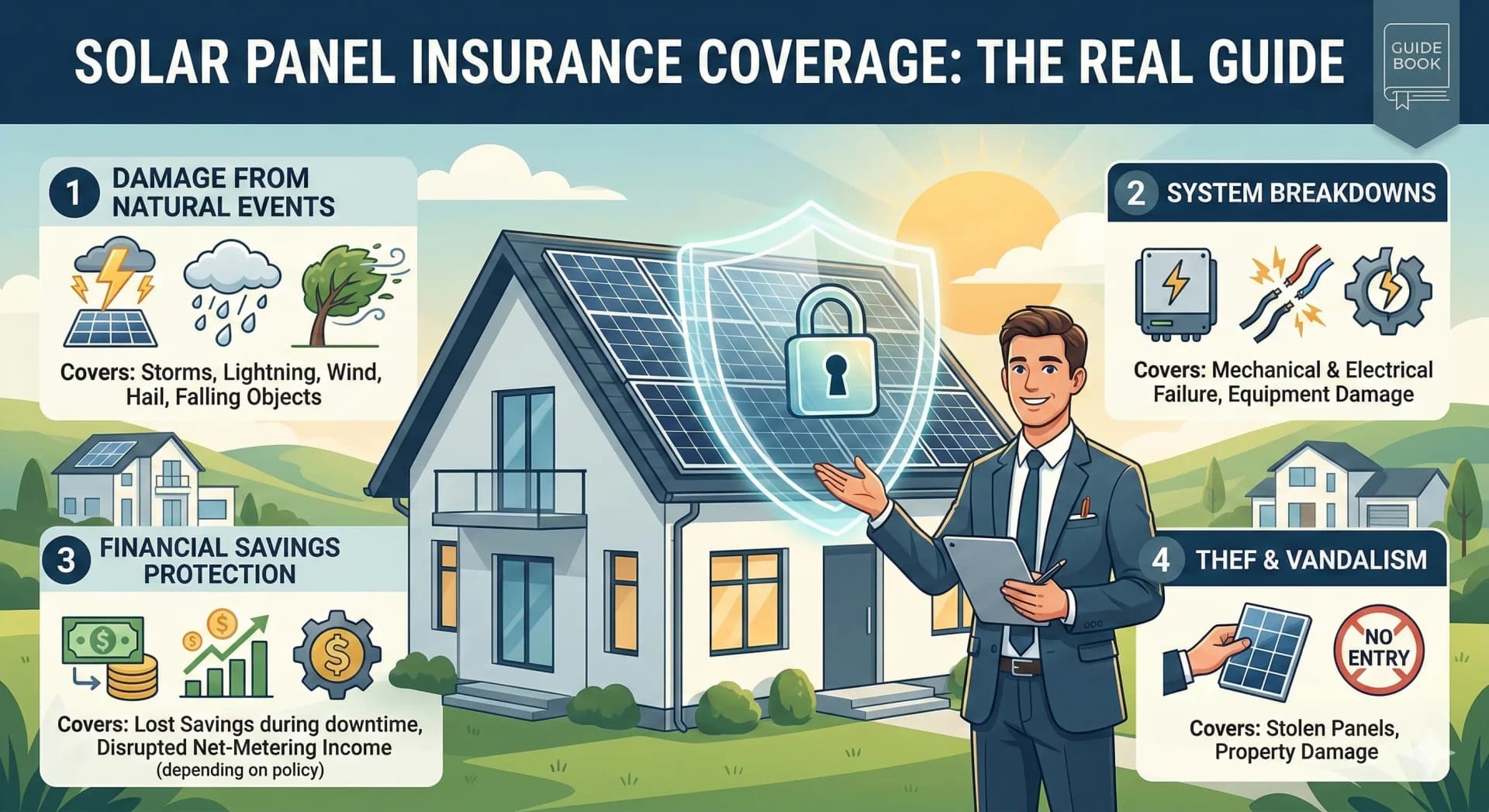
When solar panels are under your home insurance policy, you are generally protected against:
- Storm damage — Wind, hail, heavy rain
- Fire damage — If panels burn or nearby fire reaches them
- Theft — Someone removing the panels from your property
- Vandalism — Deliberate damage to the system
- Falling objects — Tree branches, debris from a storm
These are the common perils most standard policies cover. If something from that list happens to your panels, you file a claim just like you would for any other part of your home.
What Is Not Covered — The Part People Ignore
This section is more important than the one above.
Most homeowners never ask what is excluded. They assume once they have insurance, everything is handled. That thinking creates problems later.
Here is what most policies will not cover:
- Wear and tear — Panels losing efficiency over 10 to 20 years is normal aging. Insurance does not pay for that.
- Mechanical or electrical failure — If your inverter stops working internally with no outside event causing it, standard home insurance will not help.
- Flood damage — You need a separate flood insurance policy for this. Solar panels are no exception.
- Earthquake damage — Same situation. Needs a separate rider in most states.
- Installation errors — If the installer made a mistake and it caused damage later, that is the installer's responsibility, not your insurer's.
If you live somewhere with frequent floods or earthquakes, you need to plan for extra coverage. Talk to your insurer about riders or add-ons before something goes wrong.
Does Adding Solar Panels Increase Your Home Insurance Bill
This question comes up a lot. The answer is yes, but by less than most people think.
When you add solar panels, the replacement value of your home goes up. Your insurer has to cover a more expensive property. So the premium goes up a small amount.
How much? For most homeowners, it is somewhere between 30 per month.
But here is what makes that easy to accept:
- A typical residential solar system saves $100 or more monthly on electricity.
- The insurance increase is a fraction of those savings.
- You are still far ahead financially.
The more important question is not whether your premium goes up. The question is whether your coverage limit was updated to reflect the new value of your home. If not, and something happens, your payout may not be enough to replace everything.
Ask your insurer to update your home replacement cost when you install panels. Do this as a specific request, not just a vague phone call.
Roof Panels vs Ground Panels — The Coverage Gap Nobody Mentions
This is a detail that surprises many homeowners.
Roof-Mounted Panels
These sit on your home. Most insurers treat them as part of the structure. Covered under dwelling coverage. Simple.
Ground-Mounted Panels
These are on a separate structure in your yard or field. Many policies cover these under what is called "other structures" coverage. But the coverage limit for other structures is often only 10% of your total dwelling coverage.
Example: If your home is insured for 30,000. If your ground-mounted solar system is worth more than that, you have a gap.
If you have ground-mounted panels, ask your insurer for the exact coverage limit on other structures. Then compare it to what your system is worth.
If You Leased Your Panels, Read This Carefully
A large number of homeowners lease their solar panels instead of buying them. In this arrangement, the panels belong to the solar company, not you.
This changes the insurance picture.
In most cases, the solar company carries insurance for the equipment they own. You are not responsible for insuring their property.
But there are two things to watch for:
- If damage to the panels was caused by something on your property, you may still face liability questions.
- Some home insurers want to know when there is third-party equipment installed on or near your home. Not telling them could create complications during a claim.
Read your lease agreement. Then call your insurer and tell them about the leased equipment. It is a 10-minute call that can save you a lot of stress later.
What You Should Do Right After Installation
Here is a practical checklist. These steps are not complicated. Most people just never do them.
- Call your insurance company within one week of installation. Not after. Within one week.
- Get the total system cost in writing from your installer. You will need this number to update your policy.
- Ask specifically whether panels are covered under dwelling or other structures. The answer changes your coverage amount.
- Ask about equipment breakdown coverage. This is usually an affordable add-on that covers internal failures not caused by weather.
- Keep all installation documents in one place. Serial numbers, receipts, installer warranty — all of it. Claims go smoother when you have these ready.
- Review your policy once a year. Insurance needs change. Property values change. Do a quick check annually.
The Mistakes That Cost People Money
These come up repeatedly. They are all avoidable.
Not informing the insurer at all. This is the biggest one. If you never told your insurer about the panels and a claim comes in, they may not pay full value or may deny portions of it. You installed something worth $20,000 on your home and never mentioned it. That is a problem.
Thinking the deductible does not matter. If your deductible is 3,500, you are paying almost everything out of pocket anyway. Know your deductible before you install.
Assuming leased panels are fully someone else's problem. As covered above, there can still be liability issues tied to your property even with leased equipment.
Not comparing insurers. Your current insurer may not offer the best terms for homes with solar. Some companies specialize in coverage for solar properties. It is worth checking.
Skipping the annual review. Your system ages. Policy terms change. A review takes 30 minutes and keeps you from being underinsured.
FAQ
Does homeowners insurance cover solar panels damaged by hail?
Yes, in most cases. Hail falls under storm damage, which is a standard covered peril in most home insurance policies. If you live in a high-hail region like parts of the Midwest or Texas, confirm this with your specific insurer. Some policies in those areas have hail-specific deductibles that are higher than the standard deductible.
Do I need a completely separate insurance policy for solar panels?
Usually no. Your existing home insurance should cover them once you inform your insurer and update your coverage limit. Some homeowners also buy a standalone solar equipment warranty or a maintenance plan for coverage of things home insurance does not touch, like gradual performance loss or inverter failure.
What happens if my leased solar panels get damaged?
The solar company you lease from is typically responsible for insuring the equipment. Their policy should cover damage to the panels themselves. But always read your lease agreement carefully and inform your own home insurer about the leased equipment on your property.
Will my home insurance premium go up because of solar panels?
It can go up a small amount because solar panels increase your home's replacement value. For most homeowners this is 30 per month. The electricity savings from solar far outweigh this. The more important thing is making sure your coverage limit was also updated, otherwise you could be underinsured.
My Final Take
Solar panels are a good investment. The savings are real. The environmental benefit is real.
But the investment only makes full sense when it is protected properly.
Solar panel insurance coverage is not something that requires a separate policy in most cases. Your existing home insurance handles it. The work on your end is small — inform your insurer, update your coverage limit, understand what is and is not covered.
If you installed panels and have not called your insurer yet, do it this week. Not because something will go wrong, but because you spent real money on those panels and they deserve proper protection.
One phone call. That is all it takes.